
A patio that holds water after every Florida rainstorm is not just annoying. It is usually a sign that something below the surface was missed, rushed, or never built correctly in the first place. If you are searching for how to improve patio drainage, the real fix starts with understanding whether the problem is surface runoff, a failing base, or water getting trapped with nowhere to go.
In the Tampa Bay area, drainage problems show up fast. One heavy afternoon storm can leave puddles against the house, wash sand out of joints, stain pavers, and make the whole space harder to use. Over time, standing water can also lead to shifting, low spots, moss growth, and edge failure. A patio should look good, but it also has to shed water the way it was designed to.
Why patio drainage problems happen
Most drainage issues come down to slope, base preparation, or both. A patio needs a controlled pitch so water moves away from the home and toward a safe discharge area. If the surface is too flat, or if it slopes back toward the structure, water will collect where you do not want it.
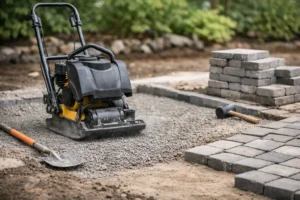
The base matters just as much. Even a beautiful paver patio can fail if the excavation depth is shallow, the subgrade is soft, or the base was not compacted in lifts. In Florida soils, that kind of shortcut tends to show up after a few rainy seasons. What starts as a small puddle often turns into settling and uneven pavers.
There is also the runoff issue. Sometimes the patio itself is built fine, but water from the roof, gutters, pool deck, lawn, or neighboring grade drains onto it. In that case, the patio is acting like the low point for the whole yard.
How to improve patio drainage the right way
The right solution depends on what is actually causing the water to stay put. Some patios need a minor correction. Others need sections lifted and rebuilt so the drainage works from the ground up.
Start by checking the pitch
A proper patio should have a slight slope that moves water away from the house. The change is subtle enough that you do not feel like you are standing on a hill, but it is enough to keep water from sitting. If puddles consistently form in the same areas, there is a good chance those spots are low or the entire field is too flat.
You can sometimes identify this with a hose test. Run water across the patio and watch where it travels, where it slows down, and where it pools. This tells you a lot about whether the problem is isolated or built into the overall grade.
If the pitch is wrong, surface patching is usually not the best answer. On a paver patio, the stronger long-term fix is often to lift the affected area, correct the base, and reset the pavers to the proper slope. On a concrete patio, the repair options may be more limited depending on the slab condition.
Look below the surface, not just at the puddle
Homeowners often focus on the visible low spot, but the bigger issue may be under the patio. If the base has washed out, settled, or was not compacted properly, the drainage problem will keep coming back until that support layer is rebuilt.
A well-built patio system includes excavation, stable subgrade preparation, compacted base material, bedding sand where appropriate, and edge restraint that keeps everything locked in place. When one of those components is weak, water finds the path of least resistance. That can lead to movement, separated joints, and recurring puddles in the same spots.
This is one reason professional hardscape installation matters so much in Florida. Drainage is not a finishing detail. It is part of the structure.
Drainage solutions that may be needed
Regrading around the patio
Sometimes the patio is not the only problem. If the surrounding yard pitches toward the hardscape, rainwater will continue to wash onto the surface no matter how attractive the pavers look. Regrading nearby soil or planting beds can redirect runoff before it reaches the patio.
This is especially common when patios sit at the back of the house under roof lines with heavy discharge points. If downspouts dump too close to the hardscape, the water volume can overwhelm the area quickly.
Installing channel drains or catch basins
When a patio sits in a tighter space or near a pool, retaining wall, or covered structure, surface drains may be the cleanest fix. A channel drain can collect sheet flow across the surface and move it to a better discharge point. Catch basins can help where water concentrates at one location.
These systems have to be placed carefully. If they are installed too high, water skips past them. Too low, and they can become debris traps. The goal is to integrate them into the patio layout so they work without hurting the look of the space.
Extending downspouts and managing roof water
A surprising number of patio drainage problems start above the patio, not on it. Gutters that overflow or downspouts that discharge at the slab edge can saturate the surrounding base and create settlement over time. Extending roof drainage away from the patio can reduce water pressure on the entire area.
This is often one of the simplest improvements, but it works best when paired with proper grading. Moving water five feet away does not help much if that area still drains right back toward the house.
Resetting sunken pavers
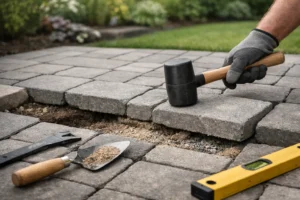
If a paver patio has low areas, loose edges, or visible settling, lifting and resetting the affected section is usually the cleanest repair. The pavers can often be reused if they are still in good condition. What matters most is correcting the base and slope underneath.
This approach is more durable than trying to force drainage with surface-level fixes alone. It also gives you the chance to address joint sand loss, edge restraint problems, and hidden washout at the same time.
When a simple fix is enough and when it is not
Not every drainage issue means full replacement. If the patio structure is solid and the problem is mainly runoff from one side, regrading, a drain, or better downspout management may solve it. If the pavers are shifting, rocking, or sinking, the repair usually needs to go deeper.
That is the trade-off homeowners should keep in mind. A lower-cost surface fix can help in the short term, but if the base is failing, you may end up paying twice. A lasting result comes from solving the source of the problem, not just the symptom.
Florida conditions change the equation
In Tampa, Brandon, Clearwater, St. Petersburg, and surrounding communities, patio drainage has to be built for sudden heavy rain, intense sun, and frequent saturation cycles. Materials expand and contract. Soil moisture changes fast. Flat lots can make water movement more difficult, and coastal humidity can make standing water even more frustrating because surfaces stay slick longer.
That is why drainage planning should be part of patio design from day one. The layout, elevation, border details, nearby structures, and runoff paths all affect performance. A patio that looks level to the eye still needs enough pitch to move water reliably.
For homeowners investing in a new outdoor space, this is where workmanship shows. A clean paver pattern is only half the job. The excavation, grading, compaction, and drainage details are what keep that patio attractive and usable season after season.
What to expect from a professional drainage correction
A professional evaluation should look at more than the patio surface. It should include the surrounding grade, roof runoff, existing drain points, low areas, and the condition of the base. In some cases, the fix is localized. In others, several elements need to work together.
At Top Pavers, that kind of approach is what protects the finished result. A patio should not just be installed to look good on completion day. It should be built to handle real weather, real use, and the kind of rain Florida delivers without warning.
If your patio is staying wet, shifting out of plane, or turning into a collection point every time it rains, the best next step is to have the drainage reviewed before the damage spreads. Water usually leaves clues early. Catching the issue now can save you from a much bigger rebuild later.
A better patio starts under the surface, and when the drainage is right, everything above it performs the way it should.